
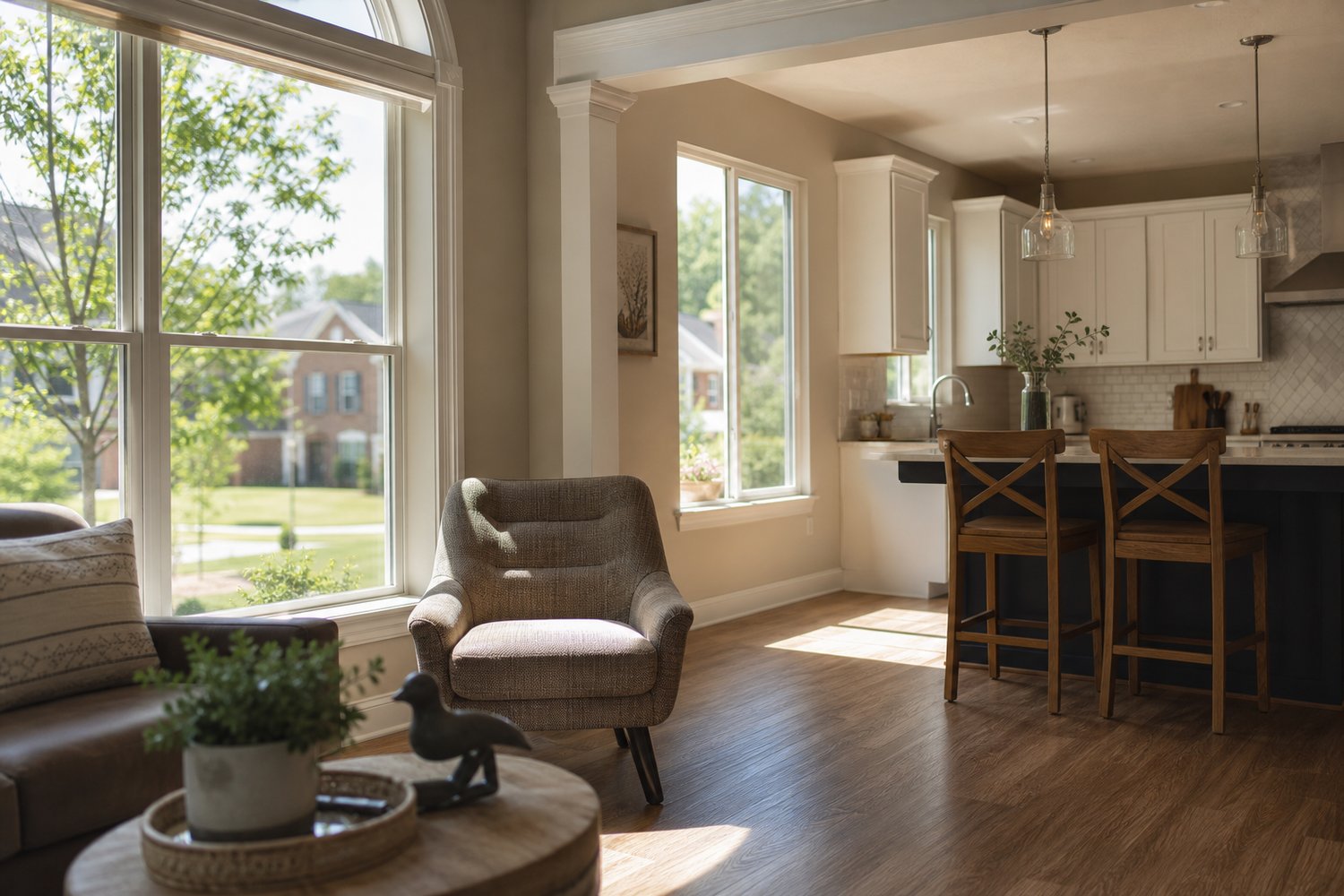
Downsizing saves money only if your total monthly housing cost drops after you count taxes, insurance, utilities, upkeep, and any HOA fee. Add the one-time costs of moving and any months you carry two homes. Build that comparison first, and let the sale price and purchase price come second.
Thank you for reading this post, don’t forget to subscribe!
What Downsizers in Hendricks County Actually Save
Will downsizing in Hendricks County save you money?
Downsizing saves money only when your total monthly housing cost drops, and that depends on far more than the gap between two prices. What downsizers in Hendricks County actually save comes from taxes, insurance, utilities, upkeep, and any HOA fee that replaces lawn care and snow removal, minus the one-time cost of moving and any months you carry two homes.
Key Takeaways
- All home types sold in Plainfield from July to September 2026 had a median sale price of $319,848, down 3.1% from the same window a year earlier, so the equity you’re counting on is area-level data until a pricing review of your own home.
- Compare monthly cost to monthly cost: mortgage or other housing debt, property taxes, insurance, HOA assessment, utilities, and maintenance, not just what one home sells for versus what the next one costs.
- An HOA that covers lawn care and snow removal can replace expenses you already pay, but the fee, the exclusions, and the snowfall trigger vary by association, so read the governing documents first.
- In Plainfield, homes of all types sold July to September 2026 took a median of 43 days from listing to going under contract, and 44% of listings had a price cut, so plan for a sale that isn’t instant.
- Moving, packing, storage, and overlap months are one-time costs that can eat a first year of savings, and they’re specific to your move, not a countywide average.
What do downsizers in Hendricks County actually save each month?
You save money only if the monthly total for the smaller home is lower than the monthly total for the home you own now. That’s the comparison I walk my clients through before we talk about listing, because the sale price of one home against the purchase price of another leaves out most of the real costs.
A smaller home usually means a smaller utility bill and less to maintain. It doesn’t automatically mean a lower payment, because a newer or more convenient home can carry a higher price per square foot, a new mortgage, and an HOA assessment. A paid-off larger home with no HOA can cost less each month than a smaller home with a new loan and a monthly fee.
Which monthly costs belong in the comparison?
Put every recurring cost for both homes side by side. Here’s the layout I use, and where each number should come from:
| Cost line | Current home | Smaller home | Where to verify it |
|---|---|---|---|
| Mortgage or other housing debt | Your current statement | A lender’s written estimate | Your lender |
| Property taxes | Your tax bill | The listed home’s tax record, which may change after the sale | County records and your title company |
| Homeowners insurance | Your policy declarations | A quote on the specific home | Your insurance agent |
| HOA assessment | Usually none, or a smaller fee | The monthly fee and what it covers | The association’s governing documents and resale information |
| Utilities | Twelve months of your bills | Ask for the seller’s history | Seller and utility providers |
| Lawn and snow service | What you pay or do yourself | Included in the HOA or paid separately | HOA documents |
| Maintenance reserve | Roof, HVAC, and exterior upkeep | Age and condition of the systems | Home inspection |
I’d compare total monthly cost instead of sale price versus purchase price every time. HOA fees that cover lawn care and snow removal replace expenses you already pay somewhere else, whether that’s a lawn service, a plow contractor, or your own weekend and equipment. That can make a monthly fee a much better deal than it looks on paper.
It can also work the other way. If you already do your own mowing and shoveling and don’t mind, the fee is a pure added cost. Your numbers decide it, and that’s where a one-on-one review with someone who knows these communities earns its keep.
How do HOA fees, moving costs, and overlap months change the math?
They can erase a year or more of monthly savings, because they hit you up front or all at once while the savings arrive slowly. Treat them as a separate one-time column, not something folded into the monthly comparison.
What should you check before counting HOA lawn care and snow removal as savings?
Confirm exactly what the association covers before you count anything. Hendricks County has a wide range of communities, from patio-home developments to larger subdivisions in places like Avon, Brownsburg, Plainfield, and Danville, and no two associations bundle services the same way. The fee amount and the services included are specific to each association, so I never estimate them from a countywide average.
Before you treat a service as a savings, ask for the current documents and check:
- Exactly what lawn care covers and what stays your responsibility, such as landscape beds, trees, or irrigation
- Whether snow removal covers driveways, walks, or both, and whether it’s triggered by a specific snowfall depth
- How often assessments have increased and what the documents say about special assessments
- What the fee does not cover, such as exterior repairs, roofs, or insurance
If you’re curious about how associations differ in the communities built with downsizing in mind, I covered the options in my community guide to patio homes in Hendricks County. For age-restricted communities, my 55+ community pros and cons post walks through the trade-offs.
Which moving and storage costs can erase the savings?
Moving costs aren’t fixed by Indiana law, and they swing with the mover, the distance, how much you’re moving, packing, stairs, storage, and timing. Downsizing often means more of the expensive parts: sorting decades of belongings, selling or donating furniture, and paying for storage when the new home can’t hold everything.
Get written estimates for your specific move and put them in the one-time column. Don’t use a generic percentage. A figure from someone else’s move doesn’t tell you much about yours.
What does it cost to carry two homes at once?
Every month of overlap adds a second set of mortgage, taxes, insurance, utilities, maintenance, and possibly HOA payments. Buying before you sell gives you a calmer move but doubles your carrying costs and adds financing risk. Selling first removes the double payment but may mean temporary housing or storage while you shop.
Neither order is automatically cheaper. It depends on how fast your home is likely to sell, how competitive the home you want is, and how your lender structures the loan. When I coordinate a sale and a purchase together, we map the overlap before you sign anything. Rushing it is how people end up with decisions they regret, which is why I wrote about downsizing in Hendricks County without rushed regrets.
What does it cost to sell the larger home?
Selling has real costs, and I’m not going to put a number on yours in a blog post. The categories are title company and settlement charges, prorated property taxes, any repairs or preparation you choose to do before listing, and the agent’s fee. Broker fees are fully negotiable and not set by law, and what you agree to is spelled out in your listing agreement. A personalized net sheet is how you see your own figures, and I’ll build one with you.
What a slab foundation and newer construction actually change about your costs
Some of the savings from downsizing don’t show up in a monthly budget line. They show up in the problems you stop having.
Many long-time homeowners in Hendricks County are leaving homes with basements or crawlspaces and moving to patio homes built on a slab. A slab foundation removes the worry of water intrusion below grade entirely. No sump pump to maintain, no crawlspace to inspect, no finished basement that quietly takes on moisture. For a homeowner who has dealt with a wet basement even once, that peace of mind is real.
If you’re moving from a home built before the early 2000s into new construction, the energy efficiency difference is also real. Newer homes are built to current code standards, which means better insulation, tighter building envelopes, and more efficient HVAC systems. That shows up in your utility bills, and it shows up in the maintenance reserve column too, because newer mechanical systems are less likely to need replacement in the first several years you own the home.
What do some HOAs cover beyond lawn and snow?
The HOA services in some Hendricks County communities go further than mowing and plowing. Depending on the association, the fee may also include:
- Mulching of common beds and sometimes individual home beds
- Weed control and lawn fertilization
- Annual gutter cleaning
- Exterior maintenance of common areas and sometimes building exteriors
None of these are universal. What one association covers, the next one excludes. The only way to know is to read the current governing documents and confirm with the association directly before you count any service as a savings. But when the package is comprehensive, it can replace a meaningful amount of what you currently pay or do yourself.
Why your health and safety belong in the downsizing math
There are things you can’t put a dollar figure on, and your health and safety are at the top of that list. That’s not a soft reason to move. It’s often the most practical one.
As we get older, reaction time, bone density, eyesight, and overall strength change. Those are facts, not fears. A home that worked perfectly at 45 can quietly become a hazard at 70. Stairs that never bothered you become a risk after a knee replacement. A large yard with a slope becomes a liability in an Indiana winter. Doorways that feel normal in a standard home can make a walker or wheelchair difficult to navigate.
Falls are the leading cause of injury among older adults in the United States, and a hip fracture can change everything fast. The goal of moving to a home designed for this stage of life isn’t to give something up. It’s to avoid the scenario where a fall or a surgery forces a move overnight, on someone else’s timeline, into a situation you didn’t choose.
Hendricks County now has communities specifically designed with that in mind: single-level patio homes with wider doorways, no-step entries, walk-in showers, and low-maintenance exteriors. The 65 and over population in Plainfield grew 66 percent in the last decade, faster than the metro area and the state, and the housing supply is still catching up to that demand. The communities being built now reflect what that generation actually needs.
I hold the SRES designation, which means I’ve been trained specifically in the housing and financial needs of buyers and sellers over 50. When I work with a client on a senior transition, we talk about the home’s layout and the neighborhood’s walkability alongside the numbers, because the right move isn’t just the one that saves money each month. It’s the one that supports a healthy, independent life for as long as possible.
If you’re weighing whether the family home still fits, my post on downsizing in Hendricks County without rushed regrets walks through how to think about the timing.
How does the Hendricks County market affect your timing?
The market is slower than it was a year ago, so your sale timeline and price should be planned, not assumed. The Indiana Association of REALTORS® characterizes Hendricks County as cooling relative to the prior year, with homes selling more slowly and days on market up substantially year over year.
The county’s September 2026 report shows 297 new listings and 610 closed sales. Those are September figures for the whole county, not a description of November conditions, and a county report can’t tell you what your street will do.
What do recent Plainfield numbers show?
Recent local market data for all home types sold in Plainfield from July to September 2026 shows:
- A median sale price of $319,848, compared with $330,000 in the same window a year earlier
- 125 homes sold, compared with 156 a year earlier
- Homes selling for an average of 98.7% of list price
- A median of 43 days from listing to going under contract
- 3.0 months of supply, up from 2.2 a year earlier
- 44% of listings with a price cut, averaging 3.1%
For the buy side, recent local market data shows 155 homes for sale now in Plainfield across all home types, with 55 new listings in the last 30 days. Those are area-level figures. What homeowners in Hendricks County actually save depends on your home’s condition, street, build year, and the timing of your sale, not on a median.
Longer marketing time also feeds back into your math. Each extra month your home sits is another month of the carrying costs I described above. If you’re weighing when to list, my post on whether fall is a good time to sell in Hendricks County goes through the timing question, and my 2026 market update for downsizers adds more context.
How do you run your own downsizing comparison?
Start with your current monthly cost, price the smaller home the same way, then add the one-time costs and the overlap. That gives you a real answer about both your monthly savings and your break-even point.
- Total your current housing cost. Use twelve months of actual bills for taxes, insurance, utilities, repairs, and lawn and snow service.
- Get a lender’s written estimate for the smaller home’s payment, if you’ll finance it.
- Request the HOA documents for any community you’re considering and confirm what the fee covers.
- Collect written moving and storage estimates for your specific move.
- Decide how you’ll handle the overlap, whether that’s selling first, buying first, or coordinating both.
- Pressure-test the sale. Ask what your home would realistically sell for based on closed sales in your neighborhood, not a wide range.
Most of my downsizing clients are surprised by one or two lines on this list, usually the HOA exclusions or the cost of overlap. It’s far better to find that out before listing than after you’ve signed a contract on the next home.
If you’d like to see how other homeowners felt as they went through this, you can read my reviews on Google, Zillow, and Realtor.com.
FAQ
Will downsizing in Hendricks County lower my total monthly housing cost?
It can, but it isn’t guaranteed. Lower utilities and maintenance help, while a new mortgage, higher property taxes on a different home, or an HOA fee can push the monthly total back up. Compare every recurring line for both homes before you decide.
How much can HOA lawn care and snow removal change the cost of owning a smaller home?
It depends on what you pay for those services now and what the specific association covers. If the fee replaces a lawn service and a plow contractor, it can be a fair swap. If it excludes things you’d still pay for, or you handle them yourself, it’s added cost. Read the governing documents for any community you’re considering.
Is it cheaper to sell first or buy first when downsizing near Brownsburg, Avon, Plainfield, or Danville?
Neither is automatically cheaper. Buying first means carrying two homes and their costs at once, while selling first can mean temporary housing or storage. The right choice depends on how quickly your home is likely to sell and how competitive the next one is, which I map out with you before you list.
What expenses should I compare besides the sale price and purchase price?
Compare property taxes, homeowners insurance, utilities, maintenance, mortgage costs, and any HOA assessment each month. Then add the one-time costs: preparation and repairs, moving, packing, storage, temporary housing, and transaction charges. Keep the two lists separate so you can see your break-even point.
How long should I expect my current home to take to sell in Hendricks County?
It varies by home and price, but recent local market data for homes of all types sold in Plainfield from July to September 2026 shows a median of 43 days from listing to going under contract. County-wide reporting from the Indiana Association of REALTORS® describes homes selling more slowly than a year ago. Your own timeline depends on condition, price, and location.
Is a patio home on a slab safer than a home with a basement or stairs?
For many older adults, yes. A slab eliminates basement stairs and the moisture risk below grade. Single-level patio homes remove the daily stair use that becomes a fall risk after a joint replacement or balance change. Wider doorways and no-step entries, common in communities designed for seniors, make the home easier to navigate if your mobility changes. The goal is a home that keeps working for you, rather than one you eventually can’t manage safely.
Run the numbers before you decide
Downsizing pays off when the monthly total drops and the one-time costs are small enough to recover, and you can only know that by comparing the whole picture. I’ll help you build the comparison for your home and the places you’re considering, one clear step at a time. Get a free home valuation and we’ll start with what your home would realistically sell for.
Equal Housing Opportunity. René Hauck is a Broker with RE/MAX Advanced Realty, licensed in Indiana since 2014, and is regulated by the Indiana Real Estate Commission. This article is general information, not legal, tax, or financial advice. Confirm your own numbers with your title company, tax advisor, or lender.
- About the Author
- Latest Posts
- Free Guides

Selling or buying a home can feel overwhelming. I guide you through each step so you always know what’s next, and you’ll have peace of mind knowing you chose the right agent to navigate it.
René Hauck is a REALTOR® with RE/MAX Advanced Realty in Plainfield, Indiana, holding the Seniors Real Estate Specialist® (SRES®) designation and Pricing Strategy Advisor (PSA) certification. With 240+ closings and $51M+ in volume across Hendricks County and West Indianapolis, she specializes in downsizing, life-transition moves, and helping sellers navigate the market with confidence. Read her client reviews on Google, Zillow, and Realtor.com or reach her at rene@indyhomepros.com.
Curious what your home is worth? What’s my home worth? · Call or text (317) 987-7068.
